Embarking on your interior design journey is exciting, but it often comes with a flood of questions, especially when choosing the right materials for your modular furniture. The durability of your kitchen cabinets, the finish of your wardrobes, and the longevity of your TV unit all depend on one critical decision: the materials you select. As an ISO 9001:2015 Certified Interior Design Firm serving Mumbai, Navi Mumbai, and Thane, we understand the unique challenges of our climate and the importance of making informed choices. This guide will demystify the world of modular furniture materials, helping you learn to choose the perfect, long-lasting options for your dream home.
The Foundation: Choosing Your Core Modular Furniture Material
Before you fall in love with a colour or finish, it’s essential to understand what lies beneath. The core material is the unseen structure of your furniture, forming its skeleton. This foundational choice is what truly determines the furniture’s durability, its ability to resist moisture and pests, and its overall longevity. Let’s compare the most popular core materials used in modern Indian homes today to help you build your furniture on a strong base.
Plywood: The Strong and Reliable Choice
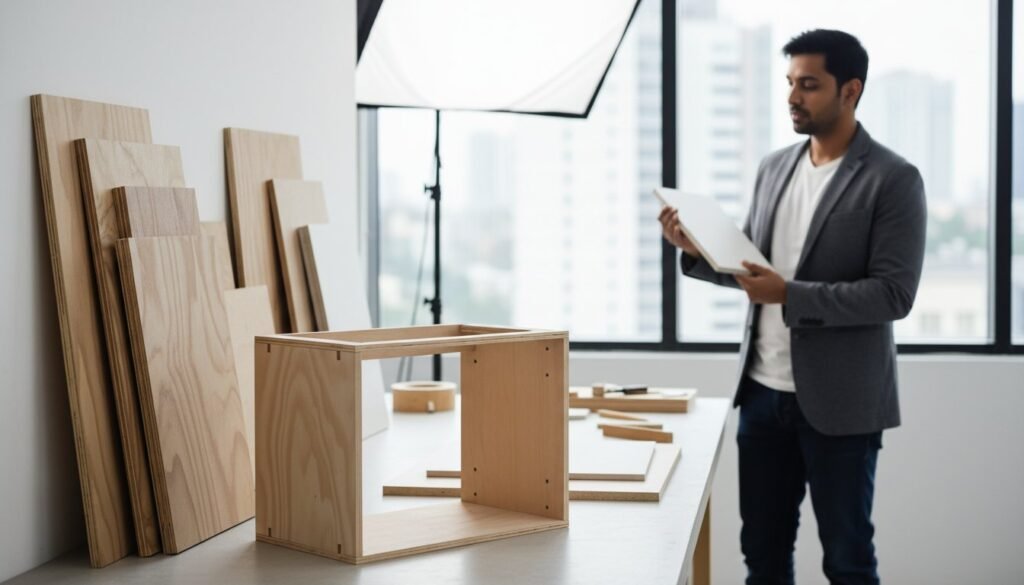
Plywood is an engineered wood sheet made from thin layers, or “plies,” of wood veneer that are glued together under pressure. Its cross-grain construction gives it immense strength and stability. When selecting plywood, it’s crucial to understand the grades. For high-moisture areas like kitchens and bathrooms, BWP (Boiling Water Proof) Grade Plywood is essential as it can withstand prolonged exposure to water. For other areas like living rooms or bedrooms, BWR (Boiling Water Resistant) Grade is a suitable alternative. The primary advantages of plywood are its high structural strength, excellent water resistance (in BWP grade), and superior ability to hold screws tightly, which prevents sagging over time. Its main drawback is that it is generally more expensive than other engineered woods.
MDF (Medium-Density Fibreboard): The Smooth Finisher
MDF is another type of engineered wood, created by breaking down hardwood and softwood residuals into fine wood fibres, which are then combined with wax and a resin binder and formed into panels using high temperature and pressure. Its defining characteristic is its incredibly smooth, dense surface, which is free of knots and grain patterns. This makes it the perfect substrate for paint and other smooth finishes. The main pros of MDF are its budget-friendly price point and its flawless surface. However, its major con is its susceptibility to water damage; it can swell and break down if exposed to moisture, making it unsuitable for wet areas.
HDF-HMR (High-Density Fibreboard – High Moisture Resistance)
Think of HDF-HMR as the stronger, more resilient sibling of MDF. It is produced in a similar way but is compressed under much greater pressure, resulting in a board that is significantly denser, stronger, and more resistant to moisture. This makes it a fantastic mid-way option that bridges the gap between MDF and Plywood in both performance and cost. HDF-HMR is frequently used for kitchen cabinets, bathroom vanities, and other areas where a combination of a smooth finish and moisture resistance is desired.
Particleboard: The Budget-Friendly Option
Particleboard is manufactured from wood chips, sawdust, and sawmill shavings that are bonded together with resin. It is the most affordable of all the core materials, but also the least durable and weakest. Its low density means it doesn’t hold screws well and can be prone to damage and sagging under heavy loads. Particleboard is best reserved for low-impact, completely dry applications such as the internal sections of wardrobes, shoe racks, or drawer bottoms where cost is the primary consideration.
The Surface: Selecting the Perfect Finish for Style & Protection
Once you’ve chosen a strong core, it’s time for the exciting part: the finish. The finish is the external layer you see and touch every day. Its role is twofold: it protects the core material from scratches, moisture, and daily wear, while also defining the aesthetic of your furniture and your entire room. Let’s explore the most popular options.
Laminates: The Durable and Versatile Workhorse
Laminates are hard, decorative sheets made by pressing together layers of plastic resins and paper. This multi-layered sheet is then bonded to the core material. Laminates are incredibly versatile and are available in a virtually endless array of colours, patterns, and textures, including matte, high-gloss, and even wood-grain effects. Their key advantages are excellent scratch resistance, ease of cleaning, and cost-effectiveness, making them a practical and popular choice for everything from kitchens to kids’ rooms.
Acrylic: For a Premium, High-Gloss Finish
Acrylic finishes provide a luxurious, high-gloss surface with a mirror-like sheen. This finish is applied to the core material as a sheet, giving cabinets and wardrobes a perfectly smooth, seamless appearance that reflects light and can make a space feel larger and more opulent. The pros of acrylic are its stunning, premium look, its inherent moisture resistance, and the fact that its colour won’t fade over time. On the downside, it comes at a higher cost and its glossy surface can easily show fingerprints, smudges, and scratches.
Veneers: The Timeless Look of Natural Wood
For those who love the classic elegance of wood, veneers offer the perfect solution. A veneer is a very thin sheet of real wood that is applied to a core material like plywood or MDF. This gives the furniture the authentic look, grain, and feel of solid wood without the high cost and potential for warping associated with it. Veneers can be stained and polished to achieve the desired shade and require periodic maintenance to keep their lustre. They are more delicate than laminates and can be susceptible to scratches.
Material Showdown: Which is Best for Your Home?
Ultimately, the right choice of material depends entirely on where the furniture will be used, your lifestyle, and your budget. As experienced interior designers, here are our expert recommendations for the most common applications in your home.
Best Materials for a Modular Kitchen
The kitchen is the heart of the home, but it’s also a zone of high humidity, steam, and potential water spills. This demanding environment requires the most robust materials. For the core, we unequivocally recommend BWP (Boiling Water Proof) Grade Plywood for its superior strength and resistance to moisture. For the finish, a high-quality Laminate or Acrylic is ideal, as both are easy to clean, non-porous, and highly durable against daily wear and tear.
Best Materials for Wardrobes and Bedroom Furniture
Bedrooms and living rooms are typically dry areas, which allows for more flexibility in material choice. Here, the focus often shifts to achieving a flawless aesthetic. For the core material, MDF or HDF-HMR are excellent choices as their smooth surfaces are perfect for achieving seamless finishes. For the finish, you have complete freedom. Laminates are a practical choice for durability, while veneers can add a touch of timeless warmth and elegance.
Quick Comparison Table: Plywood vs. MDF vs. Particleboard
To help you visualize the differences, here is a simple table comparing the key characteristics of the most common core materials. This at-a-glance guide can help you make a quick, informed decision based on your priorities. If you’re still feeling unsure, our team is always here to help. Get a free quote for your project with Purespace.
| Feature | Plywood (BWP) | MDF / HDF-HMR | Particleboard |
|---|---|---|---|
| Durability | Very High | Medium to High | Low |
| Water Resistance | Excellent | Low (MDF) to Good (HMR) | Very Poor |
| Cost | High | Medium | Low |
| Best For | Kitchens, Bathrooms, Heavy-duty furniture | Wardrobes, TV Units, Decorative Panels | Drawer bottoms, Low-use storage |
Frequently Asked Questions
Is MDF good for kitchens in Mumbai?
Standard MDF is not recommended for kitchens, especially in a humid climate like Mumbai’s, due to its poor resistance to moisture. However, HDF-HMR (High Moisture Resistance) grade can be a viable option for cabinet doors, but for the main carcass, BWP Plywood remains the safest and most durable choice.
What is the most durable material for a wardrobe?
For wardrobe carcasses, Plywood is the most durable material due to its strength and ability to hold weight without sagging. For shutters, HDF-HMR is an excellent choice as it provides a smooth surface for finishes and is more durable than standard MDF.
How can I protect my modular furniture from termites?
Always choose high-quality materials from reputable brands that offer termite-resistant properties. BWP grade plywood is chemically treated to resist termites. Additionally, ensure proper pest control is done in your home before the installation of any woodwork.
What is the difference between BWP and BWR plywood?
BWP stands for Boiling Water Proof, meaning it can withstand being submerged in boiling water for an extended period, making it ideal for kitchens and bathrooms. BWR stands for Boiling Water Resistant; it can resist moisture and humidity but is not fully waterproof, making it suitable for other furniture in the home.
Is acrylic better than laminate for kitchen cabinets?
It depends on your priority. Acrylic offers a more premium, luxurious high-gloss look but is more expensive and prone to scratches. Laminate is more practical, highly scratch-resistant, available in more variety, and more budget-friendly. Both are excellent, durable choices for kitchen surfaces.
Choosing the right materials is the first step towards creating a home that is not only beautiful but also functional and long-lasting. By understanding the core differences between these options, you can invest confidently in furniture that will stand the test of time. Ready to create a home that perfectly blends style and durability? Start Your Home Transformation Journey with Purespace and let our expert team guide you through every step of the process.